In 2026, small business payment processing is essential for improving sales, managing cash flow, and delivering a smooth customer experience. Modern payment solutions allow businesses to accept credit and debit cards, digital wallets, contactless payments, and online transactions through secure and convenient channels. Choosing the right payment provider can help businesses simplify payment operations, reduce …
In 2026, small business payment processing is essential for improving sales, managing cash flow, and delivering a smooth customer experience. Modern payment solutions allow businesses to accept credit and debit cards, digital wallets, contactless payments, and online transactions through secure and convenient channels. Choosing the right payment provider can help businesses simplify payment operations, reduce transaction friction, strengthen security, and support long-term growth. This guide explores today’s leading payment transaction methods, important provider features, transaction security, and practical considerations for choosing a payment solution that fits your business needs.The digital economy of today hinges on small business payment processing for growth and customer satisfaction. Goodpayment solutions can optimize business operations, facilitate cash flow, and enhance customer experience. This guide covers all aspects of payment transaction methods, from the selection of the best providers onward to the security of transactions.
Understanding Transaction Processing for Small-Scale Companies
A payment transaction method refers to the process or technology used by customers to pay a business for its products or services. In 2026, small businesses can accept payments through credit and debit cards, digital wallets, contactless payments, bank transfers, QR codes, and online payment gateways. Efficient small business payment processing helps companies complete transactions quickly and securely while improving cash flow and creating a convenient customer experience. Reliable transaction processing is also essential for maintaining customer trust, protecting sensitive payment information, and supporting the day-to-day operations and long-term growth of small businesses.
How Does Payment Processing Work for Small-Scale Companies?
Transaction processing is the course of action that enables businesses to accept electronic payments from customers, and it can be broadly broken down as follows:
Customer Makes Payment: Customer puts through a payment, usually a credit card processing or digital wallet.
Authorization Request: The secure transmission of payment information to the Small business payment processing, which forwards these records to the bank that issued the cards for authorization.
Authorization Response: The bank confirms the information and either approves or declines the transaction.
Transaction Completion: In case of approval, the transferring of funds to the merchant account will be looked into by the Small business payment processing.
Settlement: The merchant will then receive the funds, usually within 24 to 48 hours, depending on the processor’s policies.
This simplified processing will allow the business to process its transactions as efficiently as possible and provide added customer satisfaction and efficiency to the business.
Types of Transaction Processing Systems for Small Businesses
Small-scale companies have many options to choose from for Small business payment processing transaction methods
systems that can address a variety of needs:
Point-of-service systems are best suited for in-person transactions in brick-and-mortar stores with card readers and terminals.
Online payment processors are a safe and secure mechanism that aids online transactions through websites and mobile apps and best suit e-commerce businesses.
Mobile payment solutions enable acceptance of payments from all over via smartphones or tablets, with apps like Square or PayPal Here being quite common.
Integrated payment platforms roll together various Small business payment processing alternatives into a single solution so as to streamline for companies with different channels of transaction.
Your selection of an appropriate system depends on your business model, customer preferences, and transaction volume.
Key Components of Payment Transaction
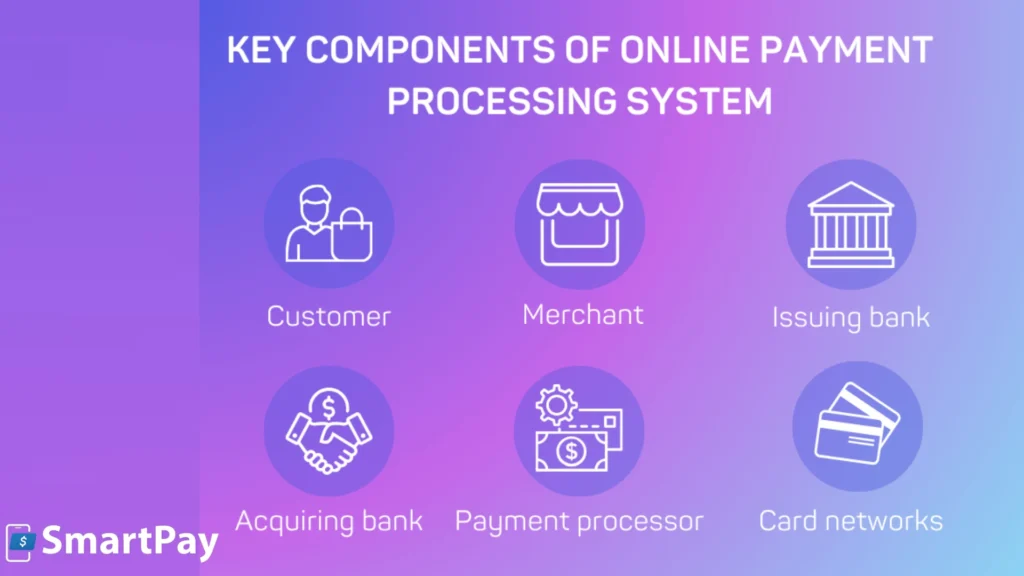
Merchant Accounts
A merchant account is a somewhat specialized bank account for businesses to accept card payments. In other words, it is the “money account” that sits between the business bank and the Small business payment processing. For a small business merchant account, the first step in enabling credit card processing transactions is to set up a merchant account.
Payment Gateways
Businesses use the Payment Gateway to send the data from the card transaction to the bank of the business. The gateway encrypts all sensitive information, allowing secure online credit card processing.
Payment Processors
Payment processors are responsible for the authorization and settlement of the transactions. They relay information to the banks to approve or deny payments. The selection of the right processor is crucial for efficient and cost-effective operations. All components work together to ensure secure and smooth credit card processing for small business operations.
Why Is Effective Payment Processing Important for Small Businesses?
Several benefits arise from efficient Transaction handling:
Better Cash Flow: Rapid transactions ensure timely access to funds.
Improved Customer Experience: Offering various secure payment methods may lead to greater customer satisfaction and loyalty.
Operational Efficiency: An integrated system minimizes manual workload and errors, thus enhancing business operations.
Competitive Advantage: Companies adopting advanced payment systems can woo tech-savvy customers while staying relevant in the competition.
Put simply, effective payment processing management is a primary driver to sustain and grow Startup companies in a comprehensive environment.
Challenges Associated with Transaction Handling for Small Businesses
Small businesses tend to encounter quite a few challenges in their payment transaction method:
Transaction Fees Cost a Lot: Whenever a payment is processed, fees are charged, which can affect the profit margins of businesses that generally work with very tight budgets. You might skip an affordable payment processing.
Integration Issues: The more difficult the integration is with existing software, the more acquiring processing will become irrelevant.
Security Concerns: The basic task of safeguarding customer data from fraudulent activities or breaches must be accomplished.
Chargebacks: Any disputed transaction can cause actual monetary loss and administrative hassle.
Limited Payment Options: Lack of a preferred payment method may cost a potential customer.
Foundational to dealing with these challenges is the selection of payment processors and the establishment of best practices.
How to Choose a Payment Processing Management Provider for Your Small Business
An intelligent decision needs several parameters to be considered:
Cost Structure: Compare transaction fees, monthly fees, and other possible charges. Try to find the hosts with the most affordable solution.
Integration Capabilities: Confirm that the processor will allow for easy integration with your existing systems, like your accounting software or e-commerce platform.
Security Features: Look for providers that provide robust security measures, including encryption and PCI DSS compliance.
Customer Support: Proper, reliable, and easy-to-access customer service is essential for fast resolution of issues.
Scalability: Create a choice for providers who will grow with your business and its changing needs.
Investigating these thoroughly might help you select a suitable provider that matches your business integrity.
Best Payment Processing Management Practices for Small Businesses
Implementing best practices will lead to better-secured and more efficient digital payment operations:
Provide a Range of Payment Methods: Accepting different forms of payment, such as credit card processing, digital wallets, or bank transfers, would go a long way toward accommodating various customer preferences.
Review Fees Regularly: These should remain competitive and reasonable with regard to your specific payment processor and to that end, fees should be assessed on a periodic basis.
Keep Up With Security Standards: Brush up on the latest security standards in order to protect information regarding customers.
Have a Clear Written Policy: Payment terms, refund policies, and any fees charged should be clearly stated for the customer.
Monitor Transactions: Reviewing transaction reports at regular intervals will help in identifying any discrepancies or outstanding issues in a timely fashion.
By following this, risk would be avoided, and customer trust would increase.
How Stripe Can Help
The Stripe product offering is meant to be a comprehensive set of tools for small business payment processing.
Seamless integr.ation: Stripe can integrate well with varied platforms, ranging from e-commerce sites to accounting software.
Available Anywhere: Stripe allows transactions with multiple currencies and payment methods, thereby facilitating international transactions.
Secure System: Stripe is PCI DSS compliant and provides digital fraud detection programs.
Transparent Pricing: Stripe charges competitively and clearly without hidden fees.
End-to-End Support: Stripe offers customer service 24/7, so any issue or inquiry can be resolved.
Small-scale companies can therefore minimize payment processes and their activities, thereby reducing costs and improving customer satisfaction.
Conclusion
Selecting the right digital payment solution can directly affect a small business’s efficiency, security, and customer experience. Understanding available payment methods, processing fees, integration requirements, and potential challenges helps businesses make informed decisions. By choosing a reliable provider and following payment security best practices, small businesses can streamline transactions, protect customer data, and support sustainable growth in 2026.
Faqs
Payment Processing FAQs 2026
What is a merchant account, and do I need one? A merchant account enables businesses to accept and process credit and debit card payments.
How do I choose the best payment processor? Compare transaction fees, supported payment methods, integrations, security, payouts, and customer support.
Are there hidden processing fees? Some providers may charge setup, monthly, gateway, chargeback, or currency-conversion fees. Always review the pricing structure.
Can I accept international payments? Yes. Many payment processors support international transactions and multiple currencies, depending on your location and provider.
How can I secure payment transactions? Choose providers with PCI DSS compliance, encryption, tokenization, fraud detection, and strong authentication.